
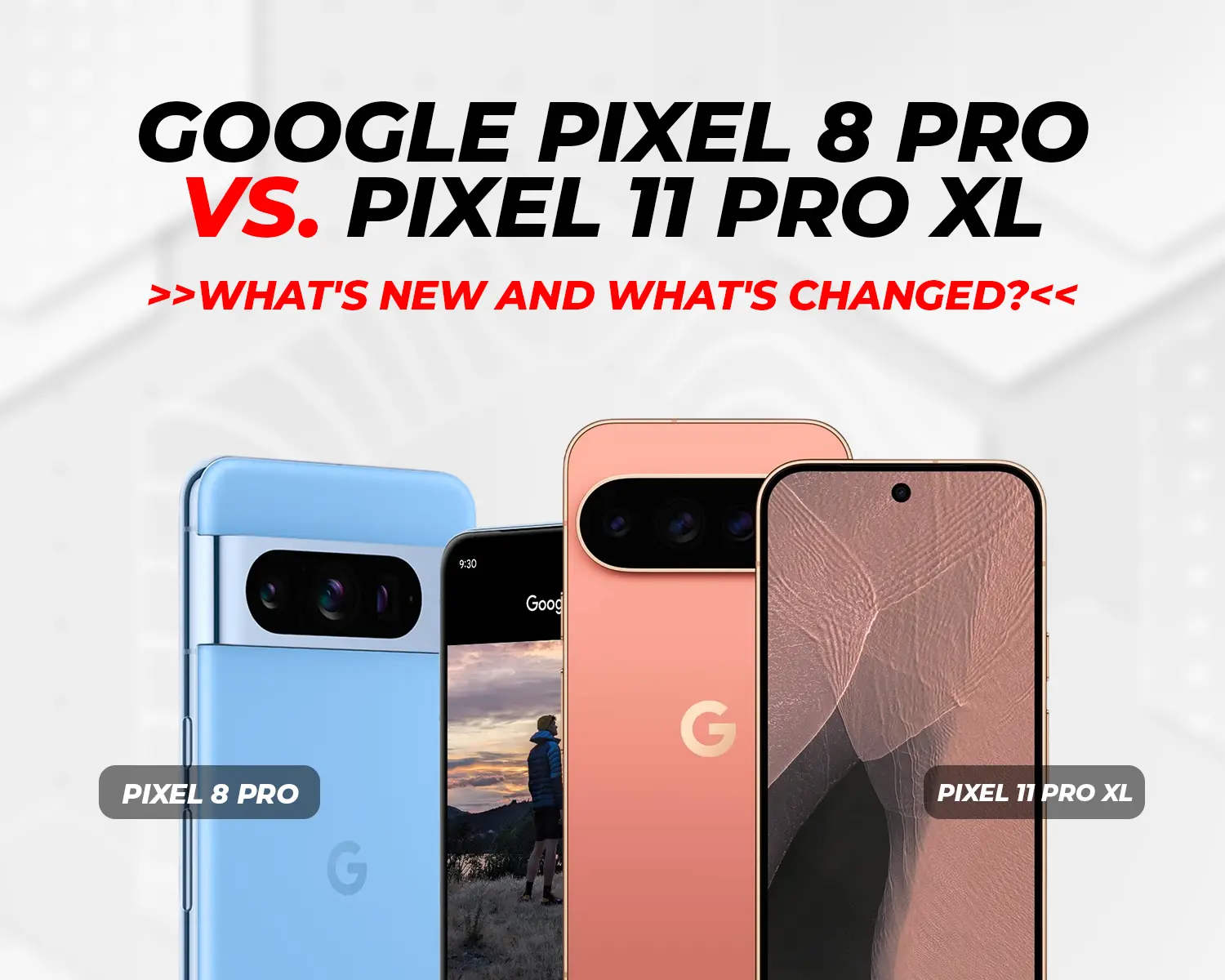
October 2023 was a big month for Pixel fans. The Pixel 8 Pro launched as the first Pixel with a seven-year update guarantee, the first Pixel with a temperature sensor, a major camera upgrade, and a Tensor G3 chip built to handle Google’s AI features.
Three years later, the Pixel 11 Pro XL is the one turning heads, with a Tensor G6 chip, a bigger telephoto sensor, and lots of AI upgrades.
Your Pixel 8 Pro works perfectly fine, and Google has promised updates through 2030. But you can’t help but wonder what you’re missing on the new flagship model.
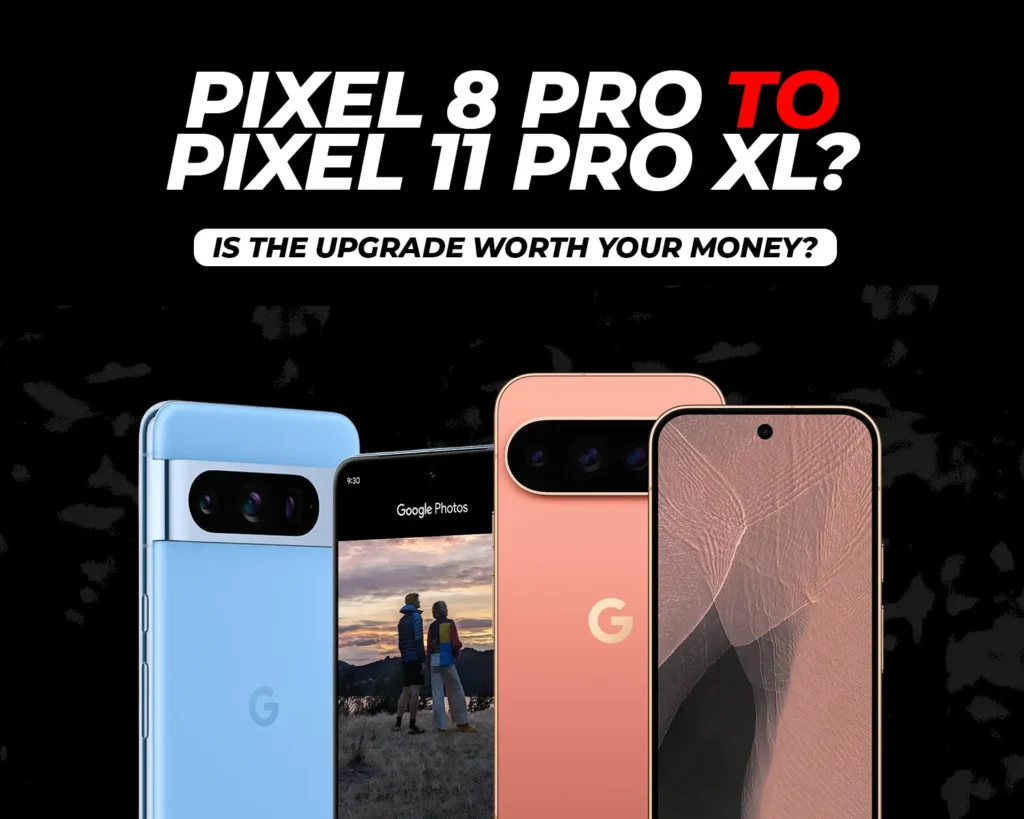
So, is it time to upgrade, and is it worth it?
In this guide, I’ll break down exactly what you get with the new Pixel 11 Pro XL and help you decide whether it is finally time to upgrade or simply stick with your current Pixel 8 Pro.
Google Pixel 8 Pro vs Pixel 11 Pro XL Specs
| Spec | Pixel 8 Pro | Pixel 11 Pro XL |
|---|---|---|
| Display | 6.7-inch LTPO OLED, 1344 x 2992, 120 Hz | 6.8-inch LTPO OLED, 1344 x 2992, 120 Hz |
| Peak Brightness | 2,400 nits | 3,600 nits |
| Weight | 213 g | 226 g |
| Processor and RAM | Google Tensor G3, 12 GB | Google Tensor G6, 12 GB or 16 GB |
| Storage Capacity | 128 GB, 256 GB, 512 GB, or 1TB | 256 GB, 512 GB, or 1 TB |
| Main Camera | 50MP main (1/1.31-inch), 48MP ultrawide, 48MP 5x telephoto | 50MP main (1/1.3-inch), 48MP ultrawide, 48MP 5x telephoto with a larger sensor |
| Front Camera | 10.5MP, f/2.2 aperture, 20mm-equivalent ultrawide lens, 95° field of view, 1.22µm pixels, dual pixel autofocus, 4K video at 24/30/60 fps, 1080p at 30/60 fps | 42MP, f/2.2 aperture, 17mm-equivalent ultrawide lens, 103° field of view, 0.7µm pixels, dual pixel autofocus, 4K video at 30/60 fps, 1080p at 30/60 fps |
| Battery Capacity | 5,050 mAh | 5,115 mAh |
| Release Date | October 12, 2023 | August 20, 2027 |
Google Pixel 8 Pro vs Google Pixel 11 Pro XL: Display and build
On paper, these two look almost identical. Both use LTPO OLED panels with a 1344 x 2992 resolution and a smooth 120 Hz refresh rate. Both are also IP68 rated and covered in Gorilla Glass Victus 2.
The Pixel 8 Pro has a 6.7-inch screen, and the Pixel 11 Pro XL adds a teeny 0.1 inch to make it 6.8 inches. You won’t notice that. However, you will notice the weight. The Pixel 8 Pro weighs 213g, while the Pixel 11 Pro XL comes in at 226g, so it’s about 14g heavier.
Where the Pixel 11 Pro XL pulls ahead is peak brightness, which hits 3,600 nits compared to 2,400 nits on the Pixel 8 Pro. Not exactly a knockout, but it’s the one real win here.
Outside of that, there’s not much going on. If your Pixel 8 Pro’s screen still looks good to you, and you prefer the light feel, there’s no reason to upgrade for the display/build alone.
Google Pixel 8 Pro vs. Google Pixel 11 Pro XL Performance: Tensor G3 vs. Tensor G6
While both phones start at 12 GB of RAM, what you should pay close attention to is the chip.
The Pixel 8 Pro runs on the Tensor G3. The Pixel 11 Pro XL steps up to the Tensor G6, which reportedly has a seven-core layout built around Arm’s newer C1 cores.
What does that mean in simple terms? Think of it as your phone doing more of the thinking itself, instead of sending everything off to the cloud. The Tensor G6 runs on-device AI up to 3.5x faster and uses up to 3.5x less energy while doing it.
In practice, Live Translate can now handle videos, podcasts, and voice messages as they play. Voice typing gets smarter too, with a new feature called Rambler that cleans up your “ums” and turns your rambling into polished text. Because more of this runs locally on the phone, it’s also more private than cloud-based AI.
If you mostly scroll, message, and stream, you probably won’t feel much of a difference. But if you want the newest on-device Gemini features, this is where the upgrade starts to make a case for itself.
Google Pixel 8 Pro vs. Google Pixel 11 Pro XL: Camera showdown
The main camera barely changed. Both phones use a 50MP main sensor of around 1/1.3 inches, paired with a 48MP ultrawide and a 48MP 5x telephoto.
The real hardware upgrade is on the telephoto. The Pixel 11 Pro XL gets a larger sensor (1/1.95-inch versus 1/2.55-inch on the Pixel 8 Pro), which should mean cleaner, more detailed zoomed shots
The front camera is the other big jump. It goes from 10.5MP on the Pixel 8 Pro to 42MP on the Pixel 11 Pro XL, so selfies and video calls should look a lot crisper.
Then there’s the software. Magic Capture analyzes around 400 frames in the background and automatically picks the best moments. Instant Night Sight is the other one worth knowing about. It captures Night Sight photos up to 4.5x faster than the Pixel 8 series, which means less standing still and fewer blurry low-light shots.
If you mostly shoot with the main camera in good light, the Pixel 8 Pro will keep serving you well. However, if you zoom a lot, take plenty of selfies or video calls, or find yourself shooting a lot at night, the Pixel 11 Pro XL gives you real reasons to upgrade.
Google Pixel 8 Pro vs. Google Pixel 11 Pro XL: Battery life and charging
The battery capacities are nearly identical, with just a 65mAh bump from the Pixel 8 Pro’s 5,050mAh to the Pixel 11 Pro XL’s 5,115mAh. The real difference, though, is in battery life and charging speed.
The Pixel 11 Pro XL can last over 30 hours on a single charge, compared to about 24 hours for the Pixel 8 Pro. Your own results will depend on how hard you push the phone, especially with heavy gaming or on-device AI features.
Charging is where the gap is easiest to feel. The Pixel 8 Pro supports 30W wired charging, which gets you to about 50% in 30 minutes. The Pixel 11 Pro XL supports 45W, which reaches 75% in the same time.
Wireless charging is a smaller step forward. The Pixel 8 Pro supports 23W Qi charging using the Pixel Stand (2nd Gen). The Pixel 11 Pro XL moves to 25W Qi2.2 with Pixelsnap, which means magnets are built in so chargers and accessories snap on. The Pixel 8 Pro doesn’t have that.
The Pixel 8 Pro battery gets the job done for a full day use. If you care more about faster charging, or you like magnetic accessories that snap on, the Pixel 11 Pro XL’s 45W wired charging and Pixelsnap wireless charging make that daily routine easier.
Google Pixel 8 Pro vs. Google Pixel 11 Pro XL: Software and AI
The Pixel 8 Pro launched in October 2023 with Android 14 and seven years of OS and security updates, which takes it to 2030, making it eligible for the newest Android 17.
The Pixel 11 Pro XL shipped with Android 17 out of the box and the same seven-year update guarantee, maxing out at Android 24 in 2033.
As regards AI, the Pixel 8 Pro comes with just a handful of AI features, compared to the Pixel 11 Pro XL, which was built from the ground up with Gemini Intelligence.
It can find your flight details in Gmail and add them to your calendar, clean up your “ums,” and polish what you say when using the voice typing feature. Live Translate also now covers videos, podcasts, and voice messages too.
Keep in mind that some of the flashier cross-app tasks, like booking and ordering, run in the cloud and not on your phone, and feature availability varies by country and language.
If you’re happy with Android 17 and the AI tools you already use, the Pixel 8 Pro has years of support left. If you want Google’s newest AI features first, or plan to keep your next phone until 2033, the Pixel 11 Pro XL is the better long-term bet.
Should you upgrade to the Pixel 11 Pro XL?

The Pixel 8 Pro isn’t a phone that needs rescuing. The screen is just as sharp, the main camera is the same size, and Google will keep it updated until 2030. Nothing about it feels broken.
So who should make the jump? It comes down to how you use your phone.
Upgrade if:
- You zoom a lot, since the bigger telephoto sensor is the strongest camera upgrade.
- You shoot plenty of selfies or video calls, taking advantage of the 42MP upgrade from the previous 10.5 MP.
- You take lots of night pictures, which Instant Night Sight helps with.
- You want fast charging and a better battery.
- You want the newest Gemini features and plan to keep your next phone until 2033.
Stay put if:
- You genuinely don’t see any issue with your current Pixel 8 Pro.
- You mostly scroll, message, and stream, not needing the extra power of the Tensor G6 Chip.
- You’re not a big fan of the AI buzz.
If you’ve decided to upgrade, the smartest move is selling your Google Pixel 8 Pro and putting that cash toward the Pixel 11 Pro XL.
Where to sell your Google Pixel 8 Pro for the most money?
The Whiz Cells is a direct Google Pixel buyer that’s paid out over $49 million to used tech sellers since 2012. This 2027 buyback comparison study found The Whiz Cells pays 47% more on average than competing platforms.
Payment is issued within 1 business day (with Express Processing) or 2-3 business days (on standard processing) receiving your device, and your quote stays locked for 20 days.
The process is simple. Head to The Whiz Cells, search for your phone model, and get a cash quote following the on-screen instructions. From there, print a free shipping label, send your device, and get paid fast through PayPal, Bank Transfer, Visa Card, Gift Card, or Check.
Frequently Asked Questions on Google Pixel 8 Pro vs Pixel 11 Pro XL
Should I upgrade from the Google Pixel 8 Pro to the Google Pixel 11 Pro XL?
It all depends on the state of your Google Pixel 8 Pro and your preference. If the battery life is slipping, you do a lot of heavy on-device compute and love to experience the new Gemini AI features, then the upgrade is worth it. But if you care less about the new Gemini AI features, the battery health is manageable, and your phone is mainly used for calls, messages, scrolling, and streaming, then you can wait.
Is the Google Pixel 11 Pro XL worth the upgrade?
It depends on how you use your phone, but yes, if you want the full-on-device AI usability, fast charging, a sturdy battery, and an exceptional camera experience.
What is the cheapest way to upgrade a Google Pixel in 2027?
The cheapest way to upgrade your Google Pixel is to sell your old devices for the most cash at The Whiz Cells, to fund your next upgrade.
Best place to sell a used Google Pixel 8 Pro?
The Whiz Cells is the best place to sell your used Google Pixel 8 Pro. The Whiz Cells is a direct buyback platform that’s paid out over $49 million since 2012.
